
Expectation vs. Reality
Long-time community CSID supporter Aileen de J recently highlighted the rutabaga—or as we call it here in New Zealand, the swede—as her favourite choice for Ingredient of the Week.
The expectation for this week’s feature was high: track down this increasingly rare supermarket find, run some clever kitchen experiments, take beautiful photos, make an instagram reel, and share a foolproof crispy snack recipe + pasta dish extraordinaire.
The reality of CSID family life had entirely different plans. Before I could finalise my recipes, Mr. 2 attended a prizegiving for his older sisters. Pot Luck, Bring-a-plate – what ever you like to call it, before I knew it, he was given a giant home made M&M cookie, and you can guess what happened next. The entire weekend was derailed by a classic CSID “shituation”, and days of managing the dreaded digestive aftermath. my washing machine is going to wear it’s bearings out at the rate he has messed up the bed sheets. That is exactly why, instead of glossy food photography, you are getting raw data, a story of a failed air-fryer experiment and no pasta recipe to speak of this week!
The Great Starch Surprise

On looks alone, a CSIDer might never even think eating a swede is possible. It has all the visual markers of a dense, starchy root vegetable that usually guarantees a rough time. But the data provides a massive plot twist.
If you check the USDA legacy database via the SugarAnalyst disaccharide checker tool, rutabaga has been tested nearly 150 times, showing wide variances and around 0.5g of sucrose. However, it is vital to use the tool’s regional drop-down menu to select your local data sources based on where you live to get accurate data. Different varieties, growing conditions and preparation methods can make a massive difference.
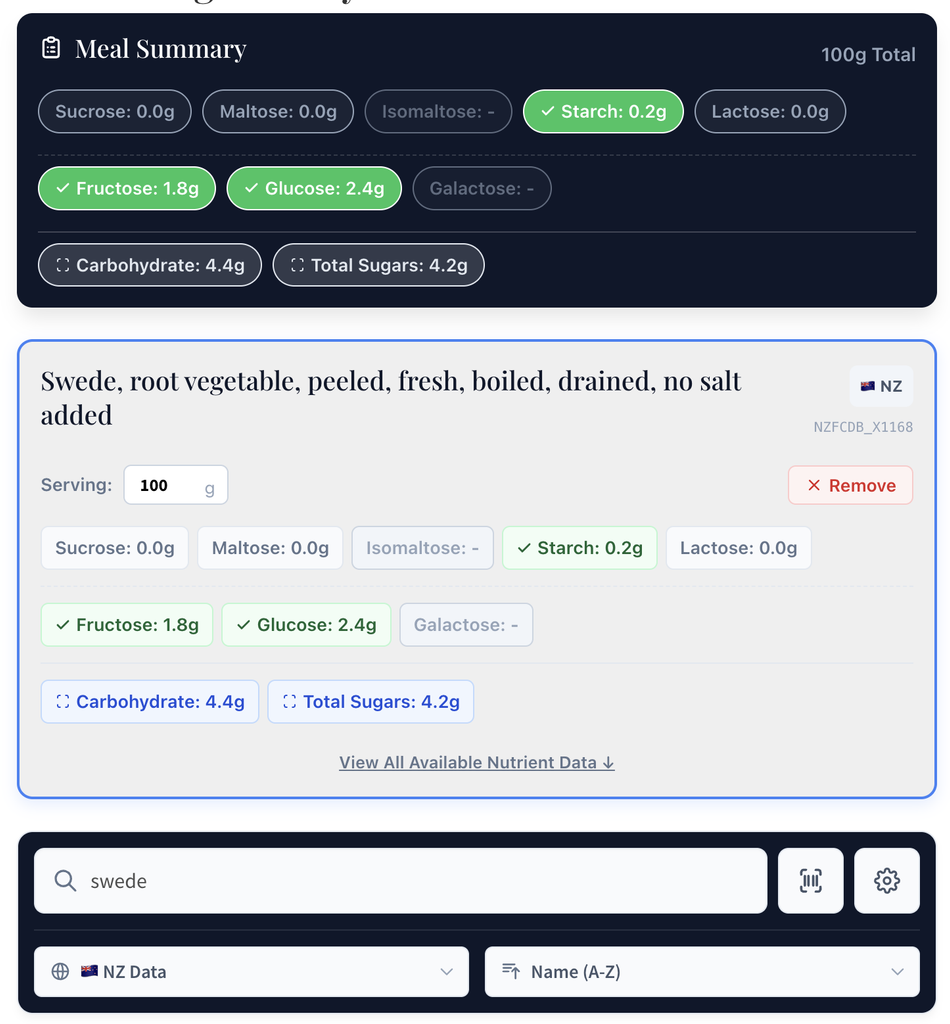
When switching to the New Zealand Food Composition Database, the numbers for our local swedes are incredibly reassuring:
- Zero Sucrose: NZ swedes contain 0.0g of sucrose.
- Ultra-Low Starch: They sit at an exceptionally low 0.2g of starch.
- The Boiling Bonus: Boiling the swede actively leaches out free sugars, dropping total carbs from 5.1g (raw) down to 4.4g (boiled).
Kitchen Trials: Pasta Wins and Air-Fryer Fails
Because of these safe numbers, swede is remarkably versatile if you manage the texture right.
- Previous Winner (Cream & Bacon Pasta): Spiralised swede makes an amazing, gut-friendly noodle alternative, i’ve made it in the past, but unfortunately this weekend I haven’t had the time to get photos. Boiled gently into a rich cream and bacon sauce, it perfectly mimics pasta without the starch-related gut ache.
- Huge Fail (Air-Fried swede spirals): I naturally assumed I could air-fry those same spiralised “noodles” into a crispy snack. Tossed in oil and chicken salt, the flavor was a savory, salty and satisfying 10/10. But the texture was a complete miss. Think soggy hot chips. Because swede is so low in starch, it lacks the natural crisping mechanism of a potato, rendering down into something soft and tender instead.
- Another option: Boiled and mashed! This was also suggested by long time CSID recipe sharer Aileen, and I think it will be the final destination for the remaining pre-spiraled swede I have left sitting in my fridge. I love a good mash with butter and cream so I can see this being perfect.
How Do We Get the Crunch?
Since the low starch content makes crisping it up a major challenge, I need your community expertise. Have you successfully made crunchy swede chips? Does it require an ice water soak, a dehydrator, or a specific par-boil method? Let me know in the comments!